


Anne Carson, Awarded D.Litt at St Andrews in 2014, Wins Nobel Prize for Literature
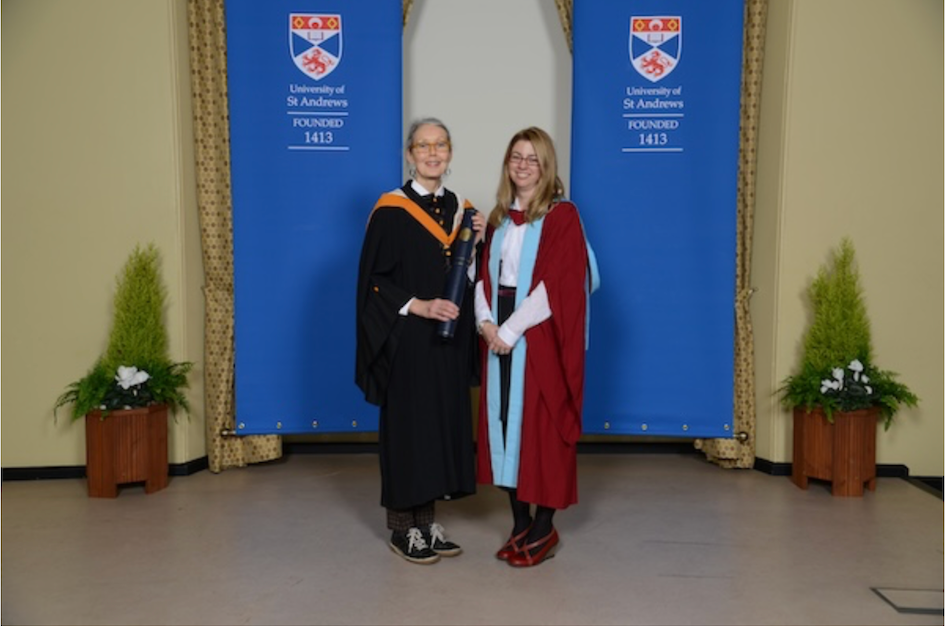
On 8 October, Canadian writer, poet, classicist, and St Andrews D.Litt awardee Anne Carson was awarded the 2026 Nobel Prize for Literature.
The Nobel Prize, regarded as the most prestigious award in global literature, is awarded annually for a lifetime's body of work, with the winner awarded a gold medal, diploma, and the equivalent of £900,000.
According to BBC News, the Nobel Prize committee said they had selected her “for her bold and inventive oeuvre that, in playful dialogue with the classical tradition, has created new forms for contemporary literature.”
Indicative of this unique style connecting the classic and contemporary, BBC News reported that in 2019, Carson performed a piece that drew a connection between Helen of Troy and Marilyn Monroe. Then, in 2021, Carson released a graphic retelling of Euripides’ ancient story, titled The Trojan Women: A Comic, and in 2025, Carson’s translation of Elektra by Sophocles was staged in London.
Considering her distinctive and creative approach, BBC News reported that Canadian Prime Minister Mark Carney said Carson’s works include “wit, imagination, and a style entirely her own.”
Prime Minister Carney also praised Carson’s Nobel Prize as “an extraordinary achievement and a proud moment for Canada.”
Born in Toronto in 1950, Carson discovered her passion for ancient Greek at school. She went on to study Classics at the University of Toronto, where she completed her BA in 1974, MA in 1975, and PhD in 1981.
In 2014, Carson was awarded a Doctor of Letters honoris causa at the University of St Andrews.
According to a recent University news article, Principal and Vice-Chancellor of the University, Professor Dame Sally Mapstone said: “Warmest congratulations to Professor Anne Carson on this richly deserved Nobel Prize in Literature. We are so honoured by her connection with the University of St Andrews, where she studied in the School of Classics in the mid-1970s under the distinguished classicist, and later Chancellor of the University, Sir Kenneth Dover FBA.
Dame Mapstone continued: “Her great gifts as a translator and writer have brought the classical world to new audiences and shown, with remarkable originality, how scholarship and creativity can enrich one another,” adding “It is a particular joy for St Andrews to see a former student and honorary graduate receive this highest literary honour.”
The University went on to explain that Carson’s year at St Andrews, “studying Greek metrics and working with [Sir Kenneth Dover FBA], helped deepen the classical expertise that would become such a distinctive foundation for her literary career.”
When Carson was awarded a Doctor of Letters in 2014, “Dover continued to speak warmly of her, and that the two might be regarded as kindred spirits in their determination to approach the classical world with both intellectual rigour and imagination,” according to the University news article.
Carson’s 2014 laureation address described her as a Classicist, translator, and poet who “makes an art out of academia and academia out of art.”
Rory Scott, a second-year student of Classics at St Andrews, told The Saint, “Anne Carson’s achievement demonstrates the enduring importance of Classics to modern literature and culture.”
Scott explained that Classics is a discipline which some might see as “fusty and outdated,” yet Carson’s award is a reminder that it can continue to “inspire world-renowned creative expression.”
Scott added, “While St Andrews is only a small building block in Carson’s career, it makes me immensely proud to study in the School of Classics.”
Image Courtesy of St Andrews University


Comments