


The Scottish Musician Who Was 20 Years Ahead of His Time
Nowadays, many contemporary bands experiment by blending folk music with modern sounds — a trend built on the foundation of the genre folktronica, which gained prominence in the early 2000s. Well-known folktronica artists such as Caribou and the Books released influential albums during this period. But a decade before these cult sensations, Martyn Bennett was already pioneering the fusion of Celtic folk and electronic music, an underrecognised trailblazer of the genre. It was in the context of an ethnomusicology lecture on why and how human beings are musical that my professor introduced Bennett, and in hindsight, there couldn’t have been a more appropriate topic. I spent the following week immersed in Bennett’s music and life.
In 1971, Bennett was born to Gaelic-speaking parents: a Welsh father and a Scottish mother, a singer and folklorist from Skye. As a child, he began learning to play the great Highland bagpipe. By age twelve, he was winning awards for his prodigious piping. In 1990, Bennett moved to Glasgow to study at the Royal Scottish Academy of Music and Drama, continuing his bagpipe lessons while studying violin and piano. It was during his final year of study that Bennett was diagnosed with cancer for the first time. After six months of treatment, he recovered and was able to graduate. In this period, Bennett reflected on his distaste for the UK’s classical music industry, and with a changed perspective on life, he began searching for alternative styles of musical expression. Throughout his exploration, Bennett was influenced by the rave scene and EDM of the early ‘90s. He bought a sampler and mixing desk and began working on his first album, experimenting with playing the fiddle and bagpipe over electronic dance beats. His self-titled album, released on an Edinburgh-based independent label in 1996, established the fusion of traditional instruments with electronic rhythms that became his signature sound.
Two years later, Bennett released Bothy Culture — an energetic follow-up merging Scottish folk melodies with elements of EDM. The album was an international success, topping college radio charts in the US and launching Bennett’s career. He performed in Paris ahead of the Scottish national football team’s World Cup match, and later at the Cambridge Folk Festival, where he sold thousands of CDs after his set. Fans began calling him “the techno piper,” and he was awarded the Glenfiddich Spirit of Scotland Award in the category of music. It was amidst this momentum that Bennett was diagnosed with cancer for the second time.
For eight months, Bennett underwent chemotherapy. Unable to perform or travel, he set up a home studio to make his next album. As his cancer progressed, Bennett grew weaker, and it became difficult to play the instruments that once came so naturally to him. In a fit of rage that his illness was leeching his ability to make music, he destroyed his instruments, later describing it as “the worst day of my entire life.” But determined to continue making music despite his inability to play his instruments, Bennett began to work on his last album, Grit.
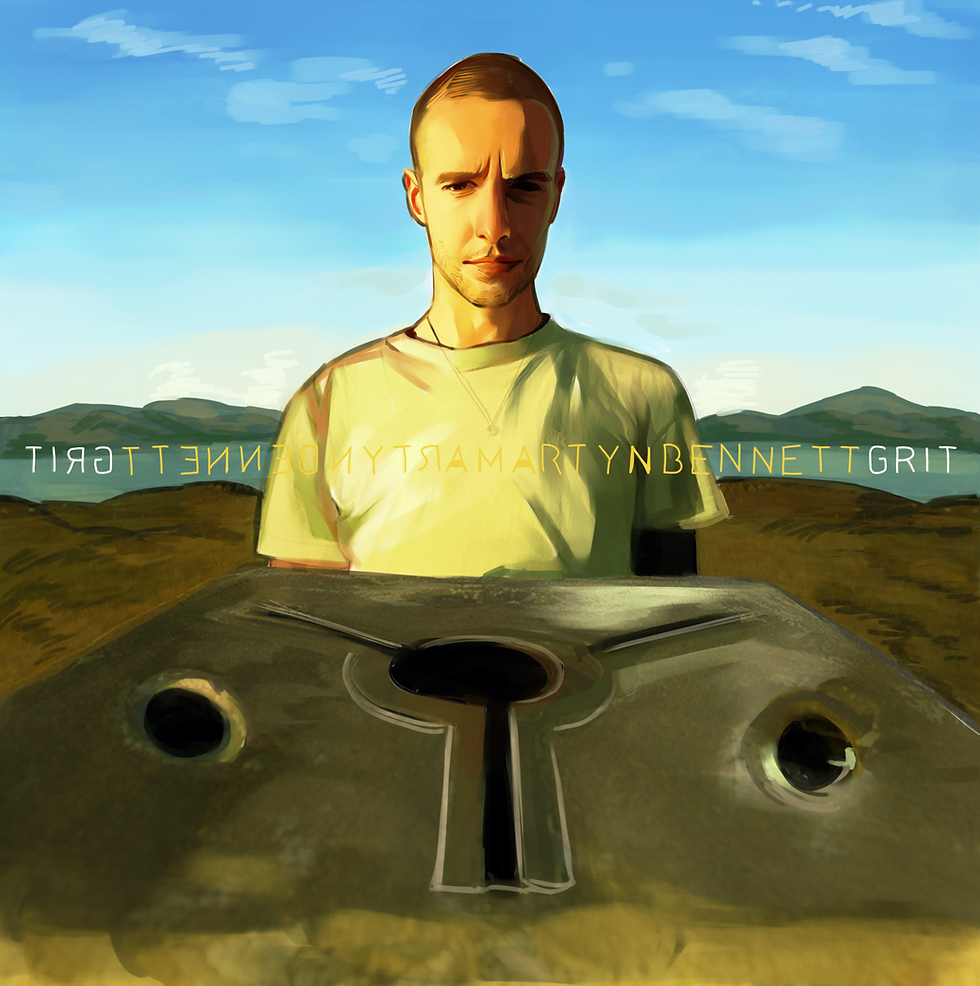
Bennett created Grit by combining old recordings of his bagpipe and fiddle playing, samples of traditional Scottish folk singers, and electronic drum beats. The album incorporates archival recordings of singers Jeannie Robertson, Lizzie Higgins, and Flora McNeil, with lyrics exploring themes of travel and movement. These were the voices Bennett listened to growing up, forming a meaningful connection to his past. On the song ‘Liberation,’ Michael Marra, a Scottish musician from Dundee, narrates an English translation of Psalm 118. His resonant voice repeats, “This is the Lord's doing; it is marvellous in our eyes,” evoking a sense of spiritual reflection and acceptance. The album was released in 2003, and two years later, Bennett passed away at 33 years old.
I return to the question of why and how human beings are musical. In Bennett’s case, it seems that music was simply inseparable from who he was. It was a means of expressing his layered identity and the story of his multidimensional life. I think you can hear this catharsis in the album Grit most strongly of all, when music served as an outlet for Bennett while he was dying. Though Bennett isn’t here to see the way his music continues to inspire listeners and musicians, his evolution of Celtic fusion continues to shape the genre today.
Illustration by Louisa Nguyen



Comments