


On Riddles, and Why We Love Them
I am carved in the skin of broken trees
I change on the tongue of he who holds me
I fall from thought to wrist and reed
My body bleeds on its white steed.
Find me, father, utter your progeny;
I bear your voice as you bear me.
I’d like to think that if I were Bilbo Baggins, lost in the hollows of Gollum’s cave, I’d be able to outwit the slimy creature in his game of riddles. However, I have trouble enough with the Monday morning crosswords, and often feel as though my life is on the line while staring at the niche pop-culture clue for 39-down. I hope my riddle, posed above, isn’t causing a similar clamminess; read carefully, and you may find the answer right before you.
Tolkien's The Hobbit reveals the sacred wager of the riddle, but also the heart of its deception. Gollum intends to eat Bilbo after failing to solve the hobbit’s riddle, despite an earlier oath to free him (I’ve never been that angered by my linguistic inadequacy). The book was famously inspired by medieval literature, of which riddles were a fantastic portion. The Exeter Book, dating to the late tenth century, contains circa 100 riddles, anonymously written and without solutions. In my second-year module on Medieval and Renaissance texts, we read these enigmas in their original Old English. This tongue, though the mother (or rather, great-grandmother) of our modern language, feels mysteriously foreign; when my lecturer read the riddles aloud, I felt as if some ancient enchantment had descended like a mist upon the hall.
The genre’s lineage is ancient, without an evident genesis. But the most faithful way to begin, I think, would be with the etymology of ‘riddles’ (aren’t words, these strange clusterings of lines, these erratic and patterned markings, riddles in themselves?). In Old English, there are kennings, poetic compound words. Two kennings for ‘man’ are gæstberend (soul-bearer) or reordberend (voice-bearer) – these cryptic compounds create riddles within riddles.
The modern English word ‘riddle’ descends from the Old English rædels, meaning riddle, imagination, or conjecture. Rædels derives from the verb rædan, which means to read, interpret, guess, or advise. Curiously, the modern English ‘read’ shares this ancestral root. The etymology of ‘riddle’ reveals its essence: an imagined medium from which truth can be divined.
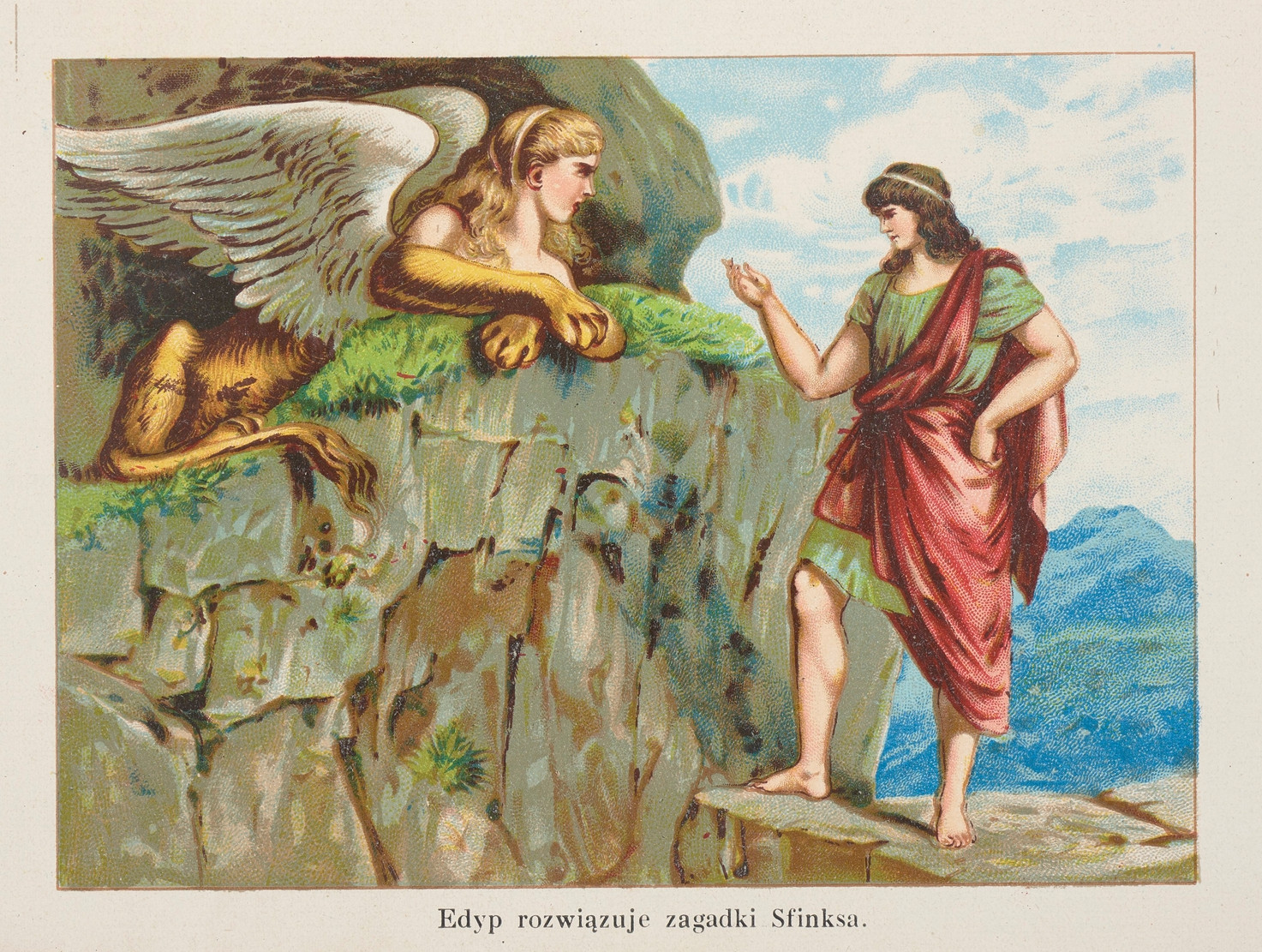
Riddles abounded in the ancient world, woven into Sophoclean tragedy, Egyptian mathematical papyrus, and Biblical parables. They seem to be as old as language itself. Though I cannot claim to know the secret of the riddle’s endurance, I can, with my little knowledge, begin to guess. Riddles are endlessly flexible, orating all aspects of our reality and supra-reality: animals, elements, tools, dreams, and divinities. Riddles are a form of poetry, of song, of mathematics, and of logic, appealing to both the radical and the rational. Their ambivalence, moreover, is irresistible; while riddles strive to tell a truth, they also love to lie.
At the riddle’s core is a secret, secret knowledge, whose unknown we have reached for since the fall from Eden. It is no wonder, then, that the Exeter riddles often open with Ic eom (I am) and close with Frige hwæt ic hatte (find what I am called); they are endowed with the human quest for identity.
So while I love solving the wordle and pouring over crosswords, I think a revival of their ancient ancestor, the riddle, is due. Why not compose a few lines in the cavernous cellar of Aikman’s, and spill your deceitful spells into the hot, mead-laden air? Free pints for the finest riddler — and may your foes be friendlier than Gollum.
Image from Artvee


Comments