


A Situationist’s Guide on How Not to Be a Tourist
Starting from the airport departures board, every stop of your holiday is connected by a Google Maps dot-to-dot designed to carve out the fastest, most efficient route, but is the journey ever only about the destination? Any line connecting two points on a map can itself be composed of countless destinations, each containing the possibility of an encounter, a surprise, or what the Situationist International called situations. Active in Europe between 1957 and 1972, the Situationists were post-war bohemians who, much like the surrealists before them and Baudelaire's flâneur, wandered through the Parisian streets in the hope of stumbling upon spontaneous, continuous, ever-changing experience. The Situationist International did not profess to be a political movement, but instead aesthetic renegades who wanted nothing less than to change the world through two tiny, almost paltry, acts of revolution. One was the dérive, or drift: the unplanned wandering through cities with no fixed destination or duration, simply letting the city itself, its streets, its buildings, its architecture and ambiance, guide you, draw you, and make you see the city in a completely new way. The second was détournement, or collage and reuse, which rejected the monotheism of artistic authorship by repurposing existing art and allowing it to take on entirely new meanings. In some way, dérive is a form of détournement: by abandoning the routes dictated by work and consumption, the drifter repurposes the city itself, cutting it up and using it beyond the urban planners’ intended functions.
The Situationists asserted that cities are drawn by the hand of capital, driving movement towards consumption, labour, and efficiency rather than curiosity and subjective exploration. Their claim formed part of a broader critique developed by Situationist artist and theorist Guy Debord, who argued that modern life had become dominated by what he called the “spectacle”: the individual reduced to the role of the spectator, passively experiencing only what is presented to them. As Debord writes, “all that once was directly lived has become mere representation.” In tourism, the spectacle transforms cities into collections of images, landmarks, and attractions: representations of a city that is only meant to be consumed. To the Situationist, however, a city is not an itinerary — it is alive, and continuously produced and re-produced through the situations that emerge between people, places, and chance.
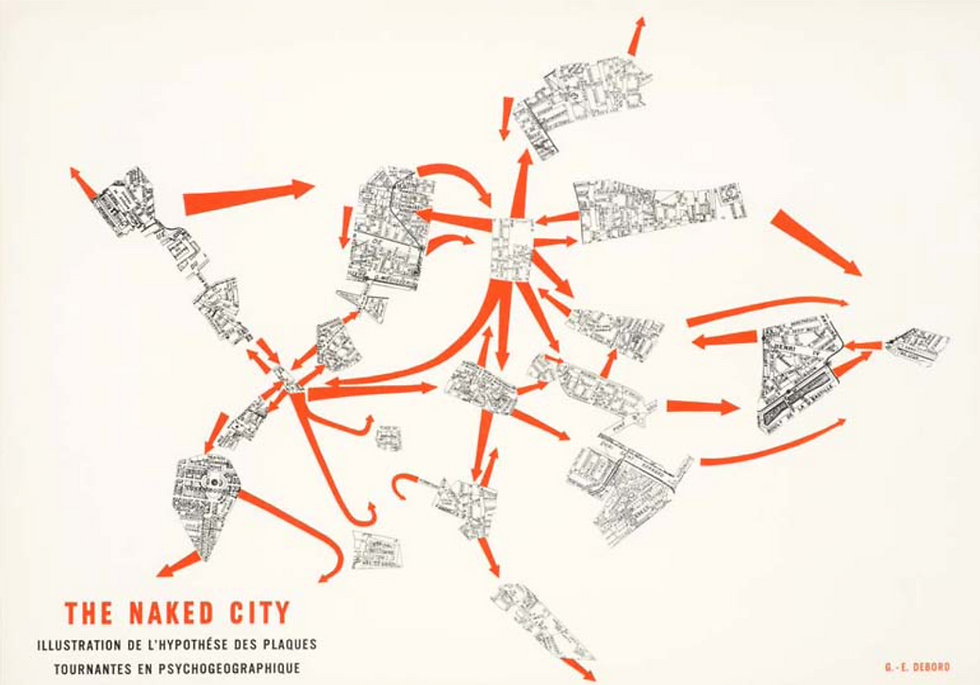
So, instead of going sightseeing this summer, go situation-seeking. Rather than stepping out of your two-star hostel with a list of museums or historical landmarks, leave with the intention of getting lost. Without a destination in mind or an estimated time of arrival, be drawn only to what catches your attention. Turn to the street with the most interesting architecture. Walk towards the sound of live music. Surrender further to the hand of chance and get off of public transport one stop early. Whilst the dérive should rely on your own judgement, chance can sometimes get a little too close for comfort. I’m sure the Situationists wouldn’t mind a bit of preliminary research. Thankfully, even Guy Debord argues that drifting is best enjoyed in the company of others. Besides, the purpose of the dérive is not to experience all that cannot be booked as an add-on to your package holiday, but to simply leave yourself open to possibility.
A few summers ago, lost in Vienna and following the sound of blues that fell out onto the street, I found myself at Cafè Kafka, where I returned later that evening on instruction from their barman. Under dim electric lighting and the backdrop of indoor smoking, a drunk saxophonist and an even more inebriated guitarist coasted their way through Paul Desmond’s Take Five. An encore from the barman himself followed, as did a series of pseudo-intellectual conversations, and it was from within those four cigarette-stained walls and the situations that unfolded between them that I, a little past the point of sobriety, saw all of Vienna.
But what if this summer does not hold the keys to the gates of some foreign city? Perhaps a Situationist would tell you that the most foreign city to you is your own, your home town, a place so familiar you don’t think to explore it. Every city contains various versions of itself, each shaped by the routes people may take, the encounters one may have, and the memories they may engender. The dérive simply offers a glimpse into the hidden iterations of the same city, and most of the time, what reveals them is nothing more than a wrong turn.
Image from Wikimedia Commons


Este artículo me pareció bastante práctico para quienes buscan información relacionada con los sorteos. La loteria nacional suele generar muchas consultas, especialmente después de cada jornada, por lo que disponer de información clara y bien presentada resulta realmente útil para los lectores.
Creating meaningful social change takes commitment, knowledge, and continuous improvement. Organizations that invest in leadership development are often better equipped to expand their reach and achieve lasting results. If you'd like to click to find out more provides mentorship, fundraising education, and practical guidance for nonprofit founders. These valuable resources help social entrepreneurs improve strategic planning, strengthen organizational skills, and develop projects that continue benefiting communities for years.
Creating meaningful social change takes commitment, knowledge, and continuous improvement. Organizations that invest in leadership development are often better equipped to expand their reach and achieve lasting results. If you'd like to click to find out more https://littlebigfund.org/ provides mentorship, fundraising education, and practical guidance for nonprofit founders. These valuable resources help social entrepreneurs improve strategic planning, strengthen organizational skills, and develop projects that continue benefiting communities for years.
We often imagine travel as pure freedom, but in reality your budget quietly shapes every choice—from flights to small everyday experiences. On the other hand, when you have providing liquidity crypto https://institutional.whitebit.com/liquidity-provision, it can become a financial foundation that works in the background. It doesn’t remove planning, but it can give more breathing room and flexibility over time. Travel feels less like compromise and more like choosing what actually fits your mood. It’s less about chasing more money and more about creating space for better decisions.