


A Night at the Opera
“What does one wear to a student opera production?” my girlfriend asked, watching me pace her room. I had dragged her along for cover — she actually knew a few things about opera; the only thing I knew was not to fall asleep and to clap when everyone else did.
“Something smart?” I ventured, tugging at my tie. In truth, opera etiquette was unfamiliar territory.
We arrived to find an audience far older than I’d anticipated. St Andrews spoils you with thousands of people your own age, so it was a rude awakening when I sat down only for my view to be eclipsed by the most spectacular bald head I’ve ever seen. Opera, of course, has never been the traditional sport of the youth — nevertheless, Suor Angelica seemed to have attracted the masses with their £7 student tickets.
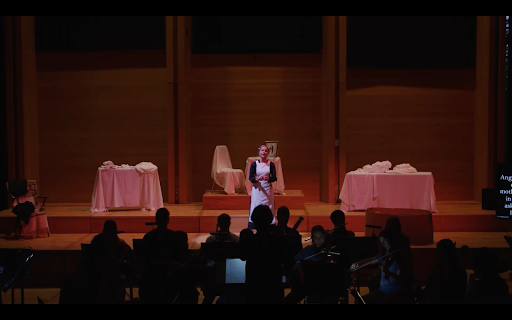
The production was a student reimagining of Suor Angelica, transplanted from an Italian convent to the laundries of the British Isles. Whether due to my own ignorance or the spiritual similarities between scrubbing sheets and cloistered penance, the shift felt natural and almost unnoticeable. Buckets, habits, and sorrow translate well.
For the uninitiated (myself included), the story follows Sister Angelica, a noblewoman locked away in a convent as punishment for bearing an illegitimate child. Her seven years of peace are disturbed when her aunt arrives to demand her signature on an inheritance document — and informs her, with the emotional subtlety of a brick, that her son has died. Grief-stricken, Angelica commits suicide and is reunited with him.
At just over an hour, it was ideal for the operatically uninitiated. Long enough to feel substantial; short enough to avoid neck pain. The libretto had been distributed online beforehand, but the team had also installed a screen at the side of the stage offering scene summaries — a godsend, as I had only skimmed the libretto lightly on the walk over.
What struck me most, however, was the scale. This wasn’t a handful of brave singers and a pianist — this was a full cast and an entire chamber orchestra. Violins, cellos, winds, brass, percussion — the whole musical ecosystem. The coordination alone must have taken weeks of rehearsal, diplomacy, and perhaps veiled threats. For a student production, the ambition was astonishing; for any production, admirable.
And the performance itself? Honestly stunning. The singing was superb; the acting precise and moving without crossing into melodrama; the orchestral playing rich and confident. Even my girlfriend — whose standards rise in direct proportion to the number of childhood hours she spent in opera houses — was impressed.
By the end, I found myself weirdly proud of the people I had observed for an hour. The cast, the musicians, the direction — all of it felt far too polished to have been produced by students who, statistically speaking, probably had tutorial readings and pesto pasta waiting for them at home.
So if you ever find yourself invited to a student opera and wondering what to wear: pull up your socks, button your shirt, and put on your tie. Their work more than deserves it.
Photo by Miller Chetwynd


The 10.0.0254 search term may represent a mistyped router address. Learn how to recognize unusual IP formatting, check the default gateway, and find the correct local address for router access.
Space Waves proves that simple mechanics can still be hard to master when reaction time is everything.